
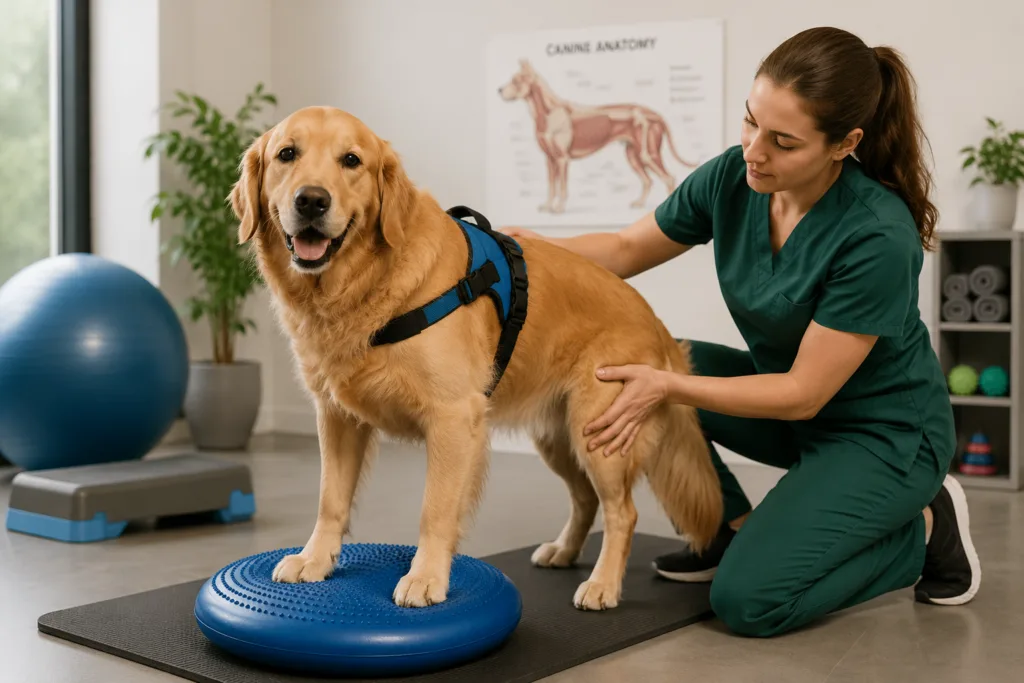
Movement is an important part of a dog’s quality of life. Whether your dog is getting older, recovering after an operation, living with reduced mobility or simply needs targeted support for their musculoskeletal system, canine physiotherapy at Dog Base Landstuhl can provide an individually adapted approach.
Every dog is different. That’s why physiotherapy should never follow a one-size-fits-all routine. We look at your dog’s individual situation, mobility and comfort and adapt the session accordingly.
🐾 Interested in canine physiotherapy?
The easiest way to contact Dog Base is by WhatsApp or email. Tell us a little about your dog, their age and why you are considering physiotherapy.
🩺 If your dog has a diagnosed condition, has recently had surgery or is currently under veterinary treatment, please mention this when contacting us.
🐕 What Is Canine Physiotherapy?
Canine physiotherapy focuses on a dog’s movement, mobility and physical wellbeing. Depending on the individual situation, carefully selected exercises and therapeutic techniques may be used to support movement patterns, muscle function, coordination and general mobility.
The goal is not simply to “exercise” the dog. A good physiotherapy session takes into account factors such as age, physical condition, previous injuries, veterinary diagnoses and the dog’s individual tolerance.
A young active dog may have completely different needs from a senior dog or a dog recovering from surgery. That’s why the physiotherapy approach should always be adapted to the individual animal.
💚 When Can Canine Physiotherapy Be Useful?
There are many situations in which dog owners consider physiotherapy. Depending on veterinary advice and the individual dog, physiotherapy may be used as supportive care in a variety of circumstances.
These may include:
- 🐾 reduced mobility
- 🦴 age-related changes in movement
- 🏥 rehabilitation following veterinary treatment or surgery
- 🐕 changes in gait or movement patterns
- 💪 support for muscle function
- ⚖️ coordination and balance exercises
- ❤️ maintaining mobility in senior dogs
- 🏃 targeted physical support for active dogs
Whether physiotherapy is appropriate depends on your dog’s individual health situation. If there is any uncertainty about pain, injury or a medical condition, veterinary assessment should always come first.
👴 Physiotherapy for Senior Dogs
Older dogs often move differently than they did when they were young. Walks may become shorter, getting up can take longer and movements that were once effortless may become more difficult.
Gentle, individually adapted physiotherapy can be particularly valuable for senior dogs because the aim is not maximum performance. Instead, the focus is often on preserving comfortable movement and supporting the dog’s everyday mobility.
Sessions should always be adjusted to the dog’s energy level and physical capabilities.
Older dogs may need more breaks and slower transitions between exercises. A calm approach is therefore especially important.
🏥 Support After Surgery or Veterinary Treatment
Physiotherapy can also play a supportive role during rehabilitation after certain veterinary procedures or injuries. In these cases, however, close coordination with the treating veterinarian can be important.
If your dog has recently undergone surgery or is receiving veterinary treatment, please tell us before the appointment and provide any relevant veterinary instructions.
We will not perform exercises that conflict with veterinary restrictions or instructions.
💪 Supporting Muscles and Movement
Healthy movement depends on many different structures working together. Muscles, joints, coordination and balance all contribute to the way a dog stands, walks and moves.
Depending on the individual dog, physiotherapy may incorporate controlled movement exercises designed to encourage appropriate use of the body.
The emphasis is on controlled, appropriate movement, not exhausting the dog.
⚖️ Coordination and Body Awareness
Some physiotherapy exercises focus on coordination and body awareness. These exercises can encourage a dog to consciously use different parts of their body and respond to changing movement situations.
The difficulty level should always match the dog’s abilities. Exercises that are suitable for one dog may be completely inappropriate for another.
❤️ A Calm and Dog-Centred Approach
Physiotherapy should not become a stressful experience. Dogs communicate constantly through their posture, movement and behaviour, and those signals should be respected throughout a session.
We therefore pay attention to your dog’s reactions and adapt the pace where necessary.
Some dogs are immediately comfortable with new exercises, while others need more time to understand what is expected of them. Patience can make a significant difference.
🩺 Physiotherapy Does Not Replace Veterinary Diagnosis
Canine physiotherapy can support dogs in many situations, but it is important to clearly distinguish physiotherapeutic support from veterinary diagnosis and medical treatment.
If your dog suddenly develops pain, severe lameness, neurological symptoms or another unexplained physical problem, the first step should be veterinary assessment.
Canine physiotherapy does not replace veterinary diagnosis or treatment. Acute injuries, unexplained pain and sudden changes in movement should be examined by a veterinarian.
🔎 What Should You Tell Us Before the Appointment?
The more information we have about your dog, the better we can understand the situation before the appointment.
When contacting us, it is helpful to mention:
- 🐶 your dog’s breed and age
- ⚖️ approximate weight
- 🩺 known diagnoses
- 🏥 previous operations or injuries
- 💊 current veterinary treatment
- 🐕 changes you have noticed in your dog’s movement
- 😟 whether your dog appears sensitive or painful in certain areas
- 📋 any instructions provided by your veterinarian
🏡 Canine Physiotherapy in Landstuhl
Dog Base offers canine physiotherapy in Landstuhl for dogs from Landstuhl and the surrounding region.
Our focus is on individual care rather than rushing dogs through standardised sessions. We want to understand what your dog needs and adapt the approach accordingly.
For many owners, having grooming and additional dog-care services available through one trusted location also makes regular appointments easier to manage.
✂️ Combine Physiotherapy with Appropriate Dog Care
Depending on your dog’s needs and the type of appointment, Dog Base also offers a range of professional grooming services.
You can learn more about:
- 🛁 Bathing & Blow-Drying
- ✂️ Haircuts & Clipping
- 🐕 Hand Trimming
- 🪮 Deshedding & Carding
- 🐾 Nail Trimming & Paw Care
- 👂 Ear Care
→ Learn more about Bathing & Blow-Drying
→ Learn more about Haircuts & Clipping
→ Learn more about Hand Trimming
→ Learn more about Deshedding & Carding
→ Learn more about Nail Trimming & Paw Care
→ Learn more about Ear Care
❓ Frequently Asked Questions About Canine Physiotherapy
Does my dog need a veterinary referral?
This depends on your dog’s situation. If your dog has a diagnosed medical condition, has recently undergone surgery or is experiencing unexplained pain or movement problems, veterinary assessment is advisable before beginning physiotherapy.
Is physiotherapy only for injured dogs?
No. Physiotherapy can be considered in different situations, including rehabilitation, mobility support for older dogs, coordination work and individually adapted physical support.
Is canine physiotherapy suitable for senior dogs?
Senior dogs can often benefit from carefully adapted movement and mobility work. The intensity should always be adjusted to the individual dog’s physical condition and comfort.
Can physiotherapy replace a veterinarian?
No. Physiotherapy does not replace veterinary diagnosis or medical treatment. Sudden pain, acute injury or unexplained changes should always be assessed by a veterinarian.
What should I bring to the appointment?
If your dog has relevant veterinary reports, instructions or information about previous surgery or treatment, please let us know. It is also helpful to tell us about medication and any movement changes you have observed.
What if my dog is nervous?
Please tell us beforehand. We can then take this into account and give your dog the time needed to become comfortable with the situation.
How do I arrange an appointment?
The easiest way is by WhatsApp or email. This allows us to respond between appointments without interrupting the dog currently receiving our attention.
🐕 Canine Physiotherapy at Dog Base Landstuhl
Would you like to find out whether canine physiotherapy could be suitable for your dog? Send us a message and briefly describe your dog’s situation.
🐾 Please include your dog’s breed, age and the reason you are interested in physiotherapy.
What care does your dog need?
Send us a recent photo and a few brief details. We will reply as soon as the salon schedule allows.